Books
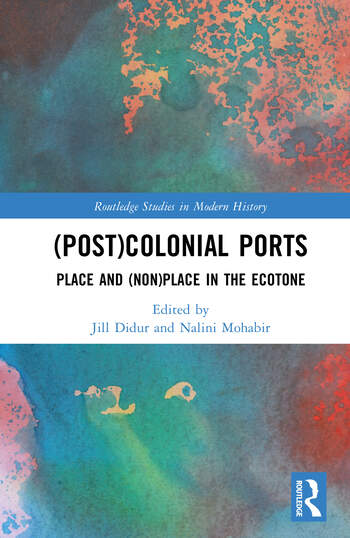
(Post)colonial Ports: Place and (Non)Place in the Ecotone. Co-edited with Nalini Mohabir. Routledge Press, May 2025.
This book enlarges the scope of understanding of the role colonial and (post)colonial ports and port cites played in creating and shaping the ecotonal cultural, historical, material, environmental, socio-political and economic contexts in a variety of formerly colonized regions such as the Caribbean, Africa, North America and Asia. Through this combined spatial and temporal approach, the book tracks the relation between ports, port cities, and colonial infrastructure such as mines, plantations, and railways, to make visible their varied impact on the human and more-than-human environments in the proposed contemporary epoch of the Anthropocene.

Global Ecologies and the Environmental Humanities. Co-edited with Elizabeth DeLoughrey and Anthony Carrigan. Routledge Press, 2015.
This book examines current trends in scholarly thinking about the new field of the Environmental Humanities, focusing in particular on how the history of globalization and imperialism represents a special challenge to the representation of environmental issues. Essays in this path-breaking collection examine the role that narrative, visual, and aesthetic forms can play in drawing attention to and shaping our ideas about long-term and catastrophic environmental challenges such as climate change, militarism, deforestation, the pollution and management of the global commons, petrocapitalism, and the commodification of nature.

Unsettling Partition: Literature, Gender, Memory. University of Toronto Press, 2006.
The Partition of India in 1947 marked the birth of two modern nation-states and the end of British colonialism in South Asia. The move towards the ‘two nation solution’ was accompanied by an unprecedented mass migration (over twelve million people) to and from areas that would become India and Pakistan.
Unsettling Partitions reinterprets the silences found in women’s accounts of sectarian violence that accompanied Partition as a sign of their inability to find a language to articulate their experience without invoking metaphors of purity and pollution.
Special Issues, Journal Articles & Book Chapters
“Reimagining the Plantation(ocene): Mulk Raj Anand’s Two Leaves and a Bud”. Postcolonial Studies. Special Issue, Planetary Solidarities: Postcolonial Theory, the Anthropocene and the Nonhuman. 25.3 (2022), 340-360. https://doi.org/10.1080/13688790.2021.1996916
“Beyond Anti-Conquest: Unearthing the Botanical Archive with Locative Media”. Intermédialités /Intermediality: History and Theory of Arts, Literature and Technologies. Special Issue, Jardiner/ Gardening. 35.spring (2020). https://doi.org/10.7202/1076376ar
“Between Landscape and the Screen: Locative Media,Transitive Reading, and Environmental Storytelling.”. Media Theory: Special Issue, Geospatial Memory. 2.1 (2018), 79-107. (Co-authored with Lai-Tze Fan).
“Walk This Way: Postcolonial Travel Writing and the Environment.” Cambridge Companion to Postcolonial Travel Writing, Cambridge UP (2018).
“‘The Perverse Little People of the Hills’: Unearthing Transculturation and Ecology in Reginald Farrer’s Alpine Plant Hunting.” Global Ecologies and the Environmental Humanities: Postcolonial Approaches, edited by Elizabeth DeLoughrey, Jill Didur, Anthony Carrigan. Routledge Press, 2015, 51-72.
“Introduction: A Postcolonial Environmental Humanities,” Global Ecologies and the Environmental Humanities: Postcolonial Approaches. edited by Elizabeth DeLoughrey, Jill Didur, Anthony Carrigan. New York: Routledge Press, 2015. 1-32. (Co-authored with Elizabeth DeLoughrey and Anthony Carrigan).
“Guns and Roses: Reading the Picturesque Archive in Anita Desai’s Fire on the Mountain” Textual Practice, 27.3 (2013), 499-522. https://doi.org/10.1080/0950236X.2013.784029
“Strange Joy: Plant-hunting and Responsibility in Jamaica Kincaid’s (Post)colonial Travel Writing” Interventions: International Journal of Postcolonial Studies. 13.2 (2011), 236-255. https://doi.org/10.1080/1369801X.2011.573223
“Cultivating Community: Counter Landscaping in Kiran Desai’s The Inheritance of Loss.” Postcolonial Ecologies: Literature of the Environment. Oxford University Press, 2011, 43-61.
“‘Gardenworthy’: Rerouting Colonial Botany in Jamaica Kincaid’s Among Flowers: A Walk in the Himalaya.” Public: Art, Culture, Ideas 41 (2013), 172-185.
“‘An Unremembered Time’: Secular Criticism in Pankaj Mishra’s The Romantics.” The Journal of Commonwealth Literature 44.2 (2009), 65-85. https://doi.org/10.1177/0021989409105119
“Secularism Beyond the East/West Divide: Literary Reading, Ethics and The Moor’s Last Sigh.” Textual Practice 18.4 (2004). 541-562. https://doi.org/10.1080/0950236042000287426
“Re-embodying Technoscientific Fantasies: Posthumanism,
Genetically Modified Foods and the Colonization of Life.” Cultural Critique 53 (2003). 98-115. http://doi.org/10.1353/cul.2003.0021
Other Works & Performance
Didur, Jill (Creator) and Tony Higuchi. Global Urban Wilds. Locative Media application launched in Montreal’s Champ des Possibles October 2021.
Didur, Jill and Caroline Alexander. Site specific installation, Layers of Landscape: Illuminating the Archive in the Grey Nuns’ Garden June 3, 2016. Displayed in connection with the Grey Nuns’ garden event, “’Un paradis sans pommiers’ Le jardins des Soeurs Grises,” Annual Conference of Critical Heritage Studies, Montreal, June 2016.
Didur, Jill and Ian Arawjo. Mobile media app, Alpine Garden Misguide/Jardin Alpine Autrement, published on the iTunes App Store (May 2015), installed in the Montreal Botanical Garden May 24, 2015 to present for use by general public visiting the garden.
 Jill Didur